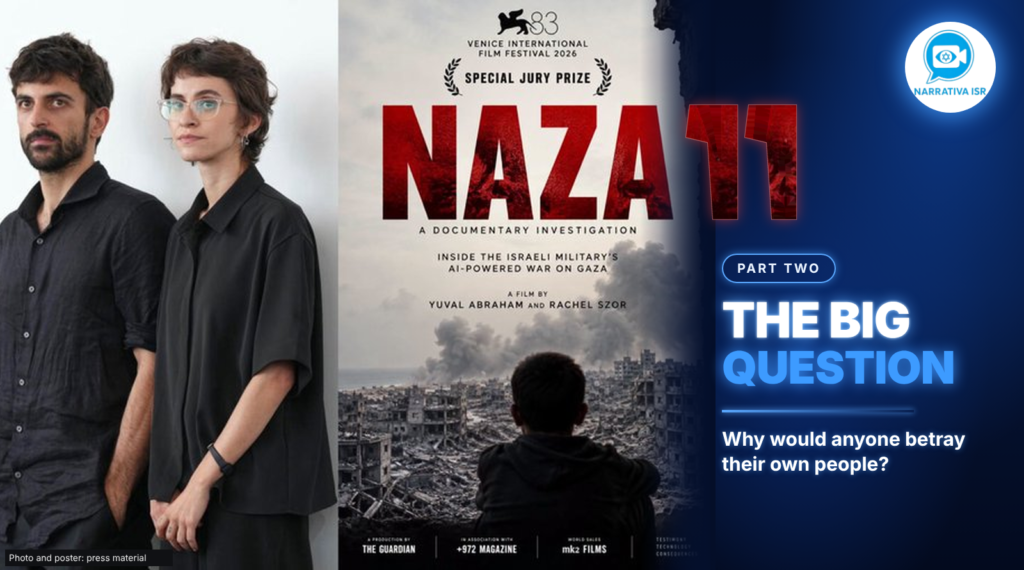
NAZA Part 2: Who Are the Directors, and Why Do They Accuse Israel? The Story of Yuval Abraham and Rachel Szor
In part one we laid out what the film „NAZA” claims, and how the Israeli army answered it point by point. But one question remained, the one every Israeli is asking today, on the bus, at work, at the Friday night table: why?
Two young Jews. Born in Israel, dreaming in Hebrew, raised in our schools. Today they travel the world telling audiences that our own soldiers are murderers. Is it for money? Out of conviction? Or for some far more human reason?
We looked into it. What we found is not the story of two monsters. It is the story of two people who slid, step by step, to where they stand today.
Who are they?
Yuval Abraham was born in 1995 in Be’er Sheva. Rachel Szor was born in 1994 and grew up in Tel Aviv. Neither of them came from poverty. Abraham himself has said in an interview that he comes from a privileged place where life is easy. They could afford to spend years not worrying about making a living.
The boy
The life of a young Israeli looks roughly like this: drafted at 18, discharged at 21, then work, studies, and by 28 a profession, a family, a mortgage and a few weeks of reserve duty every year. It is not an easy life, but there is something to show for it.
Now look at Yuval Abraham.
At 19 he is assigned to military intelligence. After one week he walks out of the training course and never serves in that role. While his peers are serving, he misses the thing that in Israel is the entry ticket to adulthood.
In his early twenties he studies Arabic, teaches Arabic, translates. He freelances for a small left-wing news site. He studies documentary filmmaking. None of it is a career. None of it is something a parent tells the neighbors about: that’s my son.
In 2019 he starts going out to the southern part of Judea and Samaria (the West Bank), to the South Hebron Hills, and begins filming. No producer. No money. No contract. Nobody has promised that this will ever become a film.
One year. Nothing.
Two years. Nothing.
Three years. Nothing.
Four years. Still nothing.
What might have gone through his mind?
We cannot see inside his head. But let us try to imagine it, because he is a human being too.
PROBABLY the question was there at every Friday night dinner, spoken or unspoken: and what are you doing these days? PROBABLY he watched his former classmates become officers, engineers, doctors, fathers. PROBABLY at night, when a person is honest with himself, he asked: what happens if at 30 I am standing here with a hard drive full of footage nobody wants to watch?
Anyone who has been there knows: this is not ordinary failure. It is the feeling that you have no place among your own people. That at home, you are nobody.
And a person at the bottom of the well grabs every hand that reaches down. He does not check whose hand it is.
Because there was one place where nobody asked what he was doing with his life. Where people were glad to see him. Where he was the Israeli who spoke their language, who listened to them, who believed what they said. There he was not a nobody. There he was the „good Jew.”
He has said it himself: by learning Arabic he „opened the other eye.” We would put it differently: he found the only audience that applauded him.
The girl
Rachel Szor attended Thelma Yellin, one of the best-known arts high schools in the country. You leave a place like that with big dreams: an exhibition, a stage, the big screen.
Then reality arrives. In 2017 she takes part in a four-month program in the desert where Israeli, Palestinian and Jordanian young people study together. By 2019 she is a cinematographer, but film databases list not a single earlier film next to her name.
PROBABLY she too watched her former classmates land roles, open exhibitions, direct. PROBABLY she too asked herself: what is the point of a camera in my hands if there is nothing to shoot?
In the South Hebron Hills there was something to shoot. And in our view, there were people who very much wanted her to shoot it.
That is how two Israelis with nothing to show at home met two Palestinian activists who, as we read it, needed exactly one thing for their story: an Israeli face.
The machine starts up
From here it moves fast.
2023: the first serious money arrives. Not from next door, but from Oslo: the Norwegian state’s film institute supports their first film, „No Other Land,” with 375,000 kroner.
2024: the film wins two awards at the Berlin Film Festival. In December the Norwegian film institute adds another 700,000 kroner.
2025: an Academy Award for the same film.
2026: Britain’s Guardian now stands behind them as producer. In September „NAZA” premieres in Venice and wins the Special Jury Prize.
In a few years, two unknowns became world stars. On one condition: Israel must be the accused. Whoever shows the other side uploads his film to the internet for free.
And here is the trap. By now their livelihood, their careers, their friends and their invitations all depend on this one position. If they said tomorrow, we were wrong, they would lose everything out there. And back home nobody is waiting for them anymore. Even if they wanted to stop, they could not.
What do they say?
That they do it out of conscience, and that they love their country. Perhaps they even believe it. But it is a strange conscience whose film, according to the Israeli army, leaves out October 7, and leaves out the fact that Hamas fights from among civilians. And it is a strange love that earns applause in Venice and tears in Sderot.
Where will they be a year from now?
Netanyahu has announced two bills: one would revoke the citizenship of anyone who defames Israeli soldiers abroad, the other would raise defamation damages twentyfold. Whether they will pass, we do not know.
But let us ask the question without them.
Where will they live? We do not believe it will be Israel. They will live where the prizes are handed out: Berlin, London, New York.
What will they do for a living? The same thing. A new film, lectures, festival juries. For exactly as long as there is something to accuse Israel of. Because that is the only thing this market buys from them.
And here is the sad end of the story: out there they will be „good Jews” only as long as they deliver. When the accusations run out, so will the applause. And by then there will be no home to come back to.
Meanwhile, we pay the price. Our soldiers, who are called war criminals. And every Jew in the world who will now be told: „even the Israelis admit it.”
What do you think: money, vanity or conviction? And is there a way back from where they have gone?
Am Yisrael Chai!